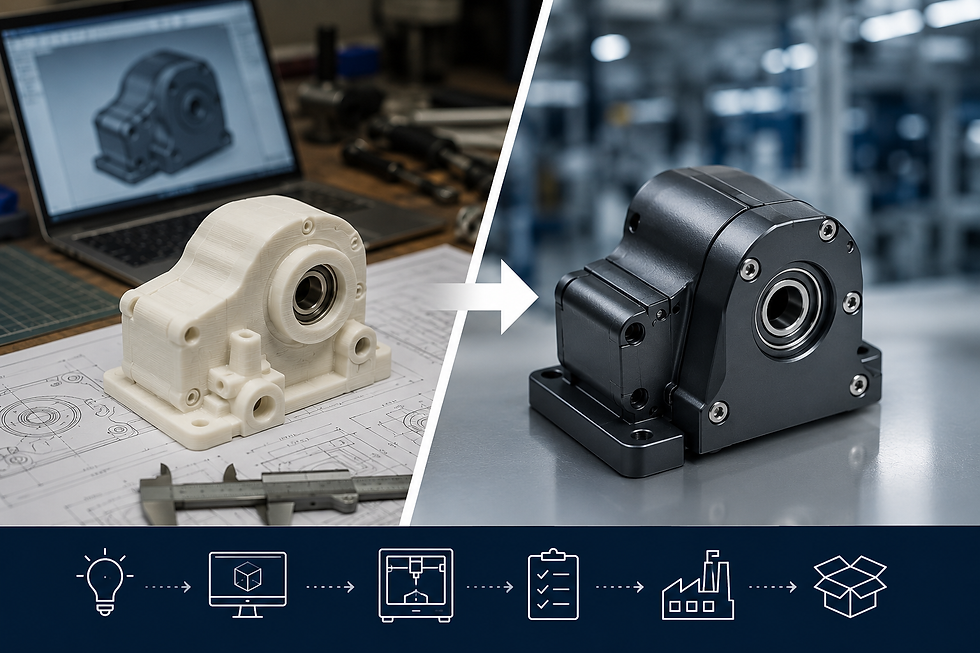
How Product Changes Can Create New Patent Opportunities
Continued product development can produce new technical solutions after a patent application has been filed. Recognizing those developments can be an important part of an ongoing patent strategy.
Your Product May Have Changed More Than Your Patent Application Originally Anticipated
Filing a patent application does not freeze the invention in place. Development continues. Designs are revised. Problems are discovered and solved. Features are added, removed, combined, or replaced. A manufacturing issue may lead to a different configuration. Testing may reveal a better way to make the product work.
Most of those changes will not require another patent filing. But continued development can produce a new technical solution that was not known when the original patent application was prepared—and that solution may present a new opportunity for patent protection.
The difficult part is recognizing when an ordinary development change has become a new patent question.
What Actually Changed?
Start with the technical change rather than its benefits.
“Lower cost,” “fewer parts,” and “better reliability” describe results. They do not identify what changed to produce those results.
For example, a product may be redesigned to use fewer components. That reduction alone is not necessarily the important development. The more relevant question is how the components were eliminated. Perhaps several functions were incorporated into a new component geometry. Perhaps a different connection between components eliminated an interface that had been causing failures. Perhaps the operating principle changed entirely.
The patent analysis should focus on the technical solution created through that development—not simply the fact that the product improved.
Was the New Solution Known When the Earlier Application Was Prepared?
A product can change after filing while still remaining within what was disclosed in the earlier patent application. The application may describe alternative configurations, broader relationships between components, or variations that encompass the later implementation.
But continued development can also produce something genuinely new.
Testing may reveal a problem that was not previously known. Solving it may lead to a configuration, mechanism, manufacturing approach, or combination of features that had not yet been conceived when the earlier application was prepared.
In that situation, the issue is not that the earlier application was drafted incorrectly or failed to capture something that should have been included. The new technical solution may simply not have existed yet.
That distinction matters because new subject matter cannot simply be added to an earlier application and treated as though it had been disclosed on the original filing date.
The relevant comparison therefore is not merely between the earlier version of the product and the later version. It is between what the earlier patent application disclosed and what was subsequently developed.
Is the Improvement Patentable—and Would Protecting It Matter?
A useful product improvement is not necessarily a patentable one.
A redesign may substantially reduce manufacturing cost, eliminate a recurring failure, improve performance, or become essential to the commercial product. Those facts can make the improvement extremely valuable to the business.
They do not establish patentability.
The later-developed solution still has to be evaluated under the applicable requirements for patent protection, including how it compares with the prior art.
The reverse can also be true. An improvement may potentially satisfy the requirements for patentability but provide little meaningful competitive protection.
This creates two separate questions:
Could patent protection potentially be obtained for the new development?
If so, would that protection be valuable enough to justify pursuing it?
Those questions should not be collapsed into one. Patentability is a legal question. Whether obtaining another patent makes sense is also a business and strategic decision.
A useful review therefore considers not only whether the later development may be patentable, but also whether competitors are likely to encounter the same problem, whether the solution is important to the commercial product, whether alternative approaches are readily available, and whether meaningful claim scope may be obtainable.
The goal is not simply to identify another invention. It is to determine whether protecting it would matter.
Product Development Can Also Change Inventorship
The people responsible for a later development may not be the same people who contributed to the subject matter of the original patent application.
An inventor may develop a new mechanism while refining a prototype. A manufacturing engineer may devise a configuration that eliminates a production problem. A member of a startup team may develop a feature that becomes part of the eventual claimed invention. An outside contractor may contribute another aspect of the solution.
Not everyone who participates in the development is necessarily an inventor. Inventorship depends on contribution to the claimed invention, not job title, seniority, ownership of the company, or simply participating in testing or implementation.
But later developments can change the inventorship analysis.
That is one reason it is useful to document significant developments as they occur: what changed, who contributed to the solution, and when the development occurred.
Reconstructing those facts months or years later can be considerably more difficult.
Timing Matters
There is no reason to send every product revision to patent counsel. Doing so would add cost and friction to normal product development without providing corresponding value.
The better approach is to recognize developments that justify another look before they disappear into the normal progression of the product—particularly when a public disclosure, sale, customer demonstration, product launch, or other commercialization activity is approaching.
A later development may warrant patent review when:
a problem is solved in a materially different way;
testing leads to a new configuration, mechanism, process, or relationship between components;
a failure mode is eliminated through a new technical approach;
an important feature is developed after the previous patent application was prepared; or
the commercial product begins relying on a solution that did not exist at the time of the earlier filing.
None of these automatically mean another patent application should be filed. They are triggers for asking whether the patent strategy should be revisited.
The Goal Is Not More Patent Applications
A company can waste substantial resources trying to patent every product refinement.
It can also make the opposite mistake: filing a patent application and treating that filing as the end of the patent process while the product continues to evolve.
The better approach sits between those extremes.
Products change because people continue solving problems. Many of those changes will have little patent significance. Others may produce the technical solution that ultimately distinguishes the commercial product from what came before it.
A sound patent strategy should be capable of recognizing the difference.
The objective is not to create another filing every time the product changes. It is to avoid discovering too late that the product changed in a way that mattered—and that the important development was not captured in
any patent filing.
About CAIAFA
CAIAFA is an engineering and intellectual property practice dedicated to helping innovators, startups, manufacturers, and investors make better technology decisions.
Every project begins with understanding the client's objectives—not fitting every challenge into the same solution. Our engineering and intellectual property capabilities are designed to stand on their own or work together, based on the goals of the client and the needs of the project.
Design. Protect. Evaluate.
This publication is provided for general educational purposes only and does not constitute legal advice, engineering advice, or any other professional advice. Every situation depends on its specific facts and circumstances.