Do I Need a Prototype Before Filing a Patent Application?
Updated: Aug 31
A working prototype is generally not required before filing a patent application. Whether developing a prototype before filing makes sense depends on the invention, its stage of development, and the objectives of the applicant.
Engineering development often reveals more than whether an invention works. It helps reveal what makes the invention valuable—and that understanding can influence intellectual property decisions.
In Brief
Many innovators assume they must build a working prototype before filing a patent application.
In most cases, that is not required.
The more important consideration is whether the invention has developed to the point where you understand how it works, how it solves the problem, and what aspects of it deserve protection.
A prototype can provide valuable insight, but building one is not a prerequisite for every patent application.
Why This Question Matters
Developing a prototype frequently improves an invention.
It may reveal design flaws, manufacturing challenges, unexpected performance issues, or opportunities for improvement that were not apparent during the initial stages of development.
Those discoveries can strengthen both the invention and the resulting intellectual property strategy.
At the same time, delaying a patent strategy simply because a prototype has not yet been built may postpone important decisions unnecessarily.
The objective is not to build a prototype before filing.
It is to understand the invention well enough to determine whether filing a patent application is appropriate.
Should You Build a Prototype Before Filing?
Rather than asking, "Do I need a prototype?", consider the questions that often guide the decision.
Do you understand how the invention works?
A patent application should describe the invention in sufficient detail for someone skilled in the relevant field to understand and implement it.
That does not necessarily require a physical prototype.
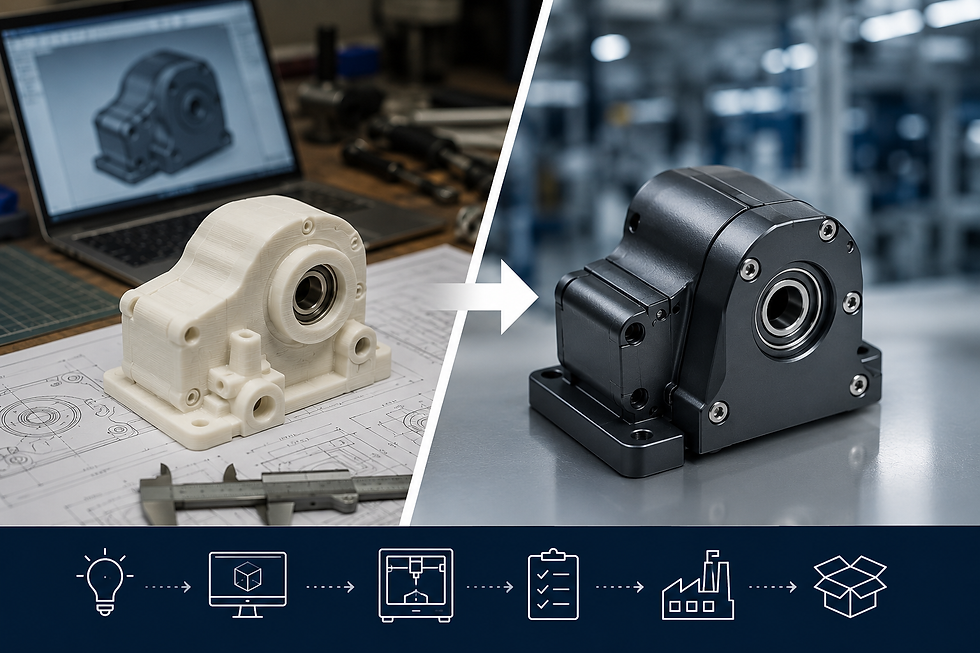
Detailed engineering drawings, CAD models, calculations, simulations, and other technical documentation may provide that understanding long before anything is manufactured.
Would a prototype likely improve the invention?
Some inventions are largely defined before they are built.
Others change significantly during prototyping and testing.
Building a prototype may uncover:
Better technical solutions
Simpler manufacturing methods
Improved reliability
Alternative component arrangements
New features worth protecting
If meaningful engineering changes are expected, those discoveries may influence the overall intellectual property strategy.
What is the next objective?
Every project progresses differently.
Imagine you've completed the engineering design of a new mechanical assembly and verified its operation through detailed CAD models and engineering analysis. Manufacturing the first prototype may take several months because of tooling and supplier lead times.
Waiting solely for a physical prototype may not always determine when a patent application should be considered.
Conversely, if the design continues to change substantially and important engineering questions remain unanswered, additional development may provide valuable insight before moving forward.
Common Misconception
"I can't file a patent application until I build a working prototype."
For many inventions, that simply is not the case.
Patent protection is generally based on describing the invention—not demonstrating that it has already been manufactured or commercialized.
A prototype may strengthen your understanding of the invention.
The more important question is whether it is likely to reveal information that should influence what ultimately deserves protection.
Key Takeaways
A working prototype is generally not required before filing a patent application.
The key consideration is whether the invention is sufficiently developed to be clearly described.
Engineering documentation may provide that understanding long before manufacturing begins.
Building a prototype often reveals improvements worth evaluating.
The appropriate timing depends on the maturity of the invention and the objectives of the project.
The CAIAFA Perspective
Many people think prototypes are primarily a legal consideration.
They are more accurately viewed as an engineering tool.
A prototype reduces uncertainty. It validates assumptions, uncovers opportunities for improvement, and increases confidence that an invention performs as intended. Whether a prototype should be completed before filing depends less on patent law than on how much additional understanding it is likely to provide.
A prototype isn't valuable because it exists—it's valuable because of what it teaches you about the invention.
About CAIAFA
CAIAFA is an engineering and intellectual property practice dedicated to helping innovators, startups, manufacturers, and investors make better technology decisions.
Every project begins with understanding the client's objectives—not fitting every challenge into the same solution. Our engineering and intellectual property capabilities are designed to stand on their own or work together, based on the goals of the client and the needs of the project.
Design. Protect. Evaluate.
This publication is provided for general educational purposes only and does not constitute legal advice, engineering advice, or any other professional advice. Every situation depends on its specific facts and circumstances.